Top Signs You Need Garage Door Service – Don’t Ignore These
The warning signs of a failing garage door are rarely subtle. A door that’s “a little slower than it used to be” isn’t aging gracefully. It’s telling you the spring has maybe 200 to 400 cycles left before it snaps, usually at 6 AM on a weekday with your car on the wrong side of it. Most garage door failures send mechanical signals weeks in advance, and homeowners misread them as normal wear. We’re going to decode those signals – the sounds, the sluggishness, the uneven panels – so you know what’s urgent, what can wait, and what’s just cold weather. If you’d rather not climb a ladder to investigate, call (866) 972-4956 and we’ll take a look.
Why Is My Garage Door So Slow? Slow Operation Is a Diagnostic Clue
A sluggish door is one of the most-overlooked early warnings. Slow operation almost always traces back to one of three things: garage door spring repair, opener strain, or track friction. Here’s how to tell them apart from the driveway.
- Spring tension loss. A torsion or extension spring that’s lost tension has to work harder to lift the same weight. The door creeps up and takes longer to close. This gets worse gradually, then suddenly.
- Opener strain. If the opener motor sounds labored – the motor pitches higher, the light flickers, or it hums before the door moves – the opener is doing more lifting than it should. On a LiftMaster or Genie unit, that usually means something mechanical downstream is fighting it.
- Track friction. Listen near the rollers. If you hear metal dragging or the door shudders on one side, the track or rollers are binding. Lubrication and adjustment are usually the fix, not a new opener.
How to tell them apart: push the door gently by hand with the opener disengaged (most openers have a manual release cord). If it’s hard to lift by hand, the spring is the problem. If it lifts easily by hand but struggles with the opener, it’s the opener or electrical. If it lifts smoothly on one side and binds on the other, it’s the track. Getting this distinction right saves you from paying for the wrong repair – something we see a lot in Reston, where doors run repeatedly through freeze-and-thaw cycles.
What Do Garage Door Noises Actually Mean? A Sound Taxonomy
Every garage door complaint has a soundtrack, and the specific noise usually points straight at the failing part. Learning to hear the difference is the single most useful skill a homeowner can develop.
- Grinding – Metal-on-metal grinding usually means worn rollers, a dry hinge, or a failing bearing plate. It’s maintenance-level until it becomes rhythmic and loud, which suggests the torsion shaft bearings are going.
- Popping – A sharp pop, especially during opening or closing, is often a dry or snapped spring or a loose cable. Treat popping as urgent. Don’t run the door until someone looks at it.
- Scraping – Scraping sounds mean the door panels are rubbing against the frame or track. That’s usually a bent track or a shifted panel, and it can damage the door if ignored.
- Squealing – High-pitched squealing is often the opener’s gears or a dry torsion spring. It’s usually fixable with lubrication and adjustment, but persistent squealing from the opener itself points to internal wear.
In our experience, popping and scraping are the two noises you never wait on. Squealing and light grinding are usually maintenance-level. In a Reston winter, cold-stiffened steel and lubricants that thicken below 30°F can make a healthy door sound briefly worse than it is – so note whether the sound fades once things warm up.
Why Is My Garage Door Uneven? It’s Never Just Cosmetic
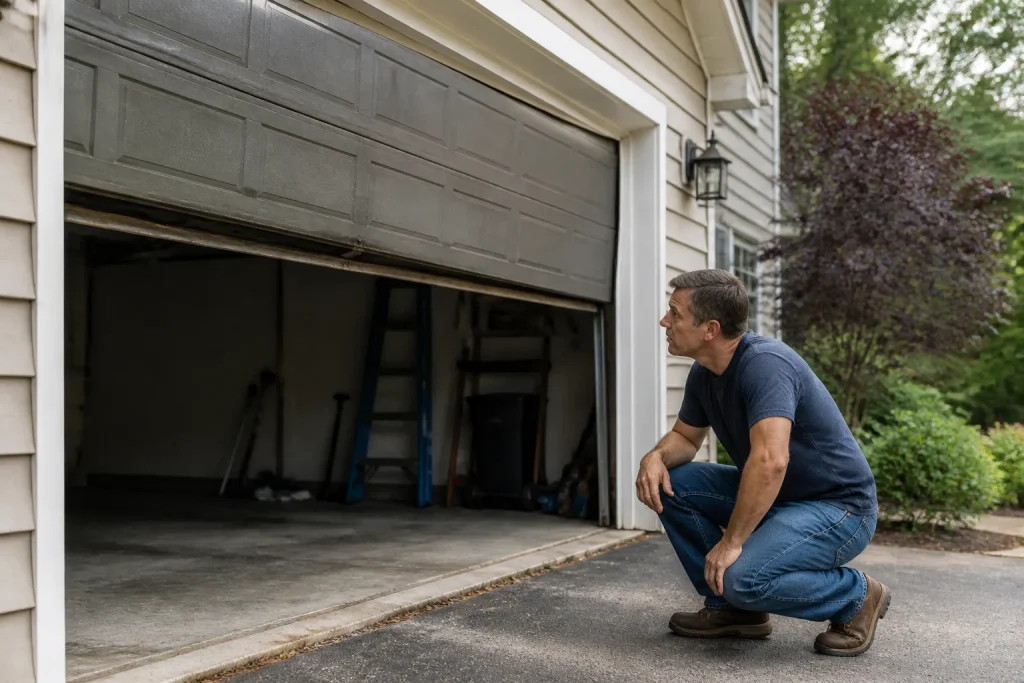
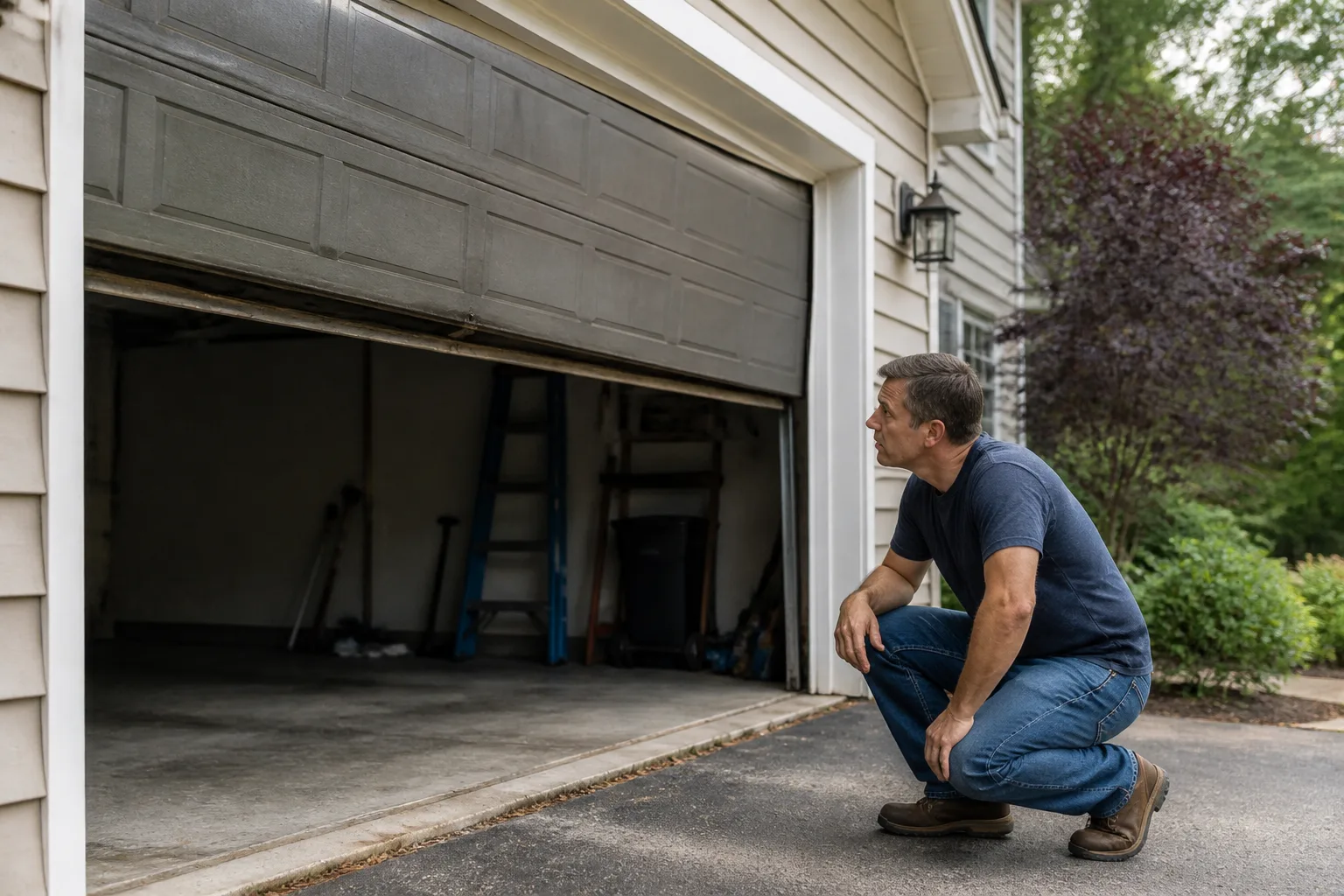
An uneven door – one side lower than the other, or a visible gap on one corner – is never a cosmetic problem. It describes a real mechanical imbalance, and it usually points to one of two systems: the cable or the spring geometry.
When one side sags, the cable on that side may be stretched, slipping off its drum, or frayed. Cables operate under serious tension, and a snapped cable is a genuine safety hazard. The other common cause is spring imbalance. On a two-spring torsion system, one spring can carry more load than the other, tilting the door. On an extension-spring setup, uneven springs do the same thing. In both cases, the door is fighting itself with every cycle, which accelerates wear on the opener and rollers.
If you see an even gap at the top or bottom of a closed door – a slice of daylight – that’s a seal issue, not a mechanical one, and it’s normal maintenance. But a door that sits crooked, bounces partway through travel, or binds on one side should be inspected before it’s run again. This is a cable-and-tension problem, and it’s not a job for a screwdriver and an afternoon.
The 10-Second Balance Test Every Reston Homeowner Should Run
You can check your door’s health twice a year without tools, and the result tells you roughly how much spring life remains. Here’s the test:
- Close the door fully.
- Pull the manual release cord on the opener to disengage it. The door is now running on springs and weight only.
- Lift the door by hand to about waist height, then let go.
- Watch what it does.
A healthy door holds its position at roughly any point, or drifts down only slightly. A door that drops quickly is losing spring tension and has limited life left. A door that rises on its own is over-tensioned. A door that won’t move by hand or feels unusually heavy has lost most of its spring support – stop running it and get it looked at.
Reston’s temperature swings make this test especially valuable. A door that held perfectly in fall can drift noticeably by late winter as cold-stiffened springs and seals change the load. Run the test once when the season changes in spring and again before winter. If the result worries you, call (866) 972-4956 for a free estimate on what it’ll take to get ahead of the failure.
Cold-Weather Symptoms vs. Mechanical Failure
Not every symptom is a breakdown. In Reston winters, two complaints show up constantly and are easily mistaken for failure.
The first is a door that reverses for no apparent reason. Cold-weather reversal is usually the safety sensors at the base of the track, not the door mechanics. Frost, condensation, or dirt on the sensor lens can interrupt the beam and trigger a reversal. Clean the lenses and check alignment before assuming the opener is dead. If a Clopay or Amarr door reverses only when temperatures drop below 30°F, that’s often the weather seal stiffening and increasing resistance – the opener’s safety logic reacts to the strain.
The second is stiff, slow operation below freezing. Cold-thickened lubricant on springs and rollers, plus a stiffer bottom seal, makes a healthy door feel sluggish. If the door runs normally once the day warms up, you’re looking at weather behavior, not mechanical failure. But if the stiffness persists in mild temperatures, or the door hangs on the way up, that’s spring or opener strain.
One weather-driven problem we won’t tell you to fix yourself: if your door reverses or stops because of an obstruction or a struggling spring, don’t force it repeatedly. A door that fights its own mechanism can snap a cable. Call us and we’ll sort out which symptom is weather and which is wear.
When to Call a Pro (And Which Service You Actually Need)
Some checks are yours to run – cleaning sensors, watching the balance test, listening for new sounds. But springs and cables are high-tension, safety-critical components, and they’re the ones most general handymen won’t touch. Our technicians work on the major residential brands by name – Genie and LiftMaster openers, Clopay and Wayne Dalton doors among them – so we’re familiar with whatever system is already on your home, not just one platform.
If you’ve ruled out weather and still have a slow, noisy, or uneven door, that’s your cue. We handle garage door opener repair as well as the door itself, so one call covers the whole system. And when the door won’t move at all, emergency service is part of what we offer.
Related services in Reston: if your symptom points to garage door repair, we can advise on whether a fix or full replacement makes more sense – and we install Clopay, Amarr, Wayne Dalton, and Raynor doors, so a replacement quote comes from the same technician doing the diagnostic.
The Bottom Line
The signals are almost always there before a failure – the slow grind, the popping spring, the sagging side, the door that won’t balance. The trick is knowing which ones mean “schedule a service visit” and which mean “stop running it right now.” Springs and cables are the latter. Noise and sluggishness are usually the former. And weather-driven symptoms in a Reston winter deserve a second look once temperatures rise before you replace anything. Our technicians have up to 15 years of experience, and we’ll tell you what’s actually failing rather than what’s easiest to sell.
If you’re in Reston and need help, Garage Door Repair Reston offers free estimates – call (866) 972-4956. One call covers the door and the opener, and the price is quoted and agreed before any work starts.
Frequently Asked Questions
You usually know weeks in advance if you’re paying attention. The door gets slower and heavier to lift by hand, the balance test shows it dropping quickly instead of holding position, or you hear popping and grinding. Any of those means the spring is losing tension and should be inspected before it snaps.
No. An uneven door describes a cable or spring imbalance, and both run under dangerous tension. Adjusting them without the right tools and training risks serious injury. Call (866) 972-4956 and we’ll diagnose which system is causing it.
Probably not. Cold-weather reversal is usually the safety sensors reacting to frost, dirt, or a stiffening seal, or the opener sensing extra resistance from thickened lubricant. Clean the sensor lenses and see if it clears. If it reverses in mild weather too, that’s a mechanical problem worth a free estimate.
Stop using the door. A pop usually means a spring has snapped or a cable has let go, and running the opener on it can cause further damage or a safety hazard. Call (866) 972-4956 for emergency service – estimates are free.
Written by the team at Garage Door Repair Reston.
Need Garage Door Help?
Call Garage Door Repair Reston - the local pro we connect you with is licensed and insured, here with fast after-hours help in Reston.
(866) 972-4956